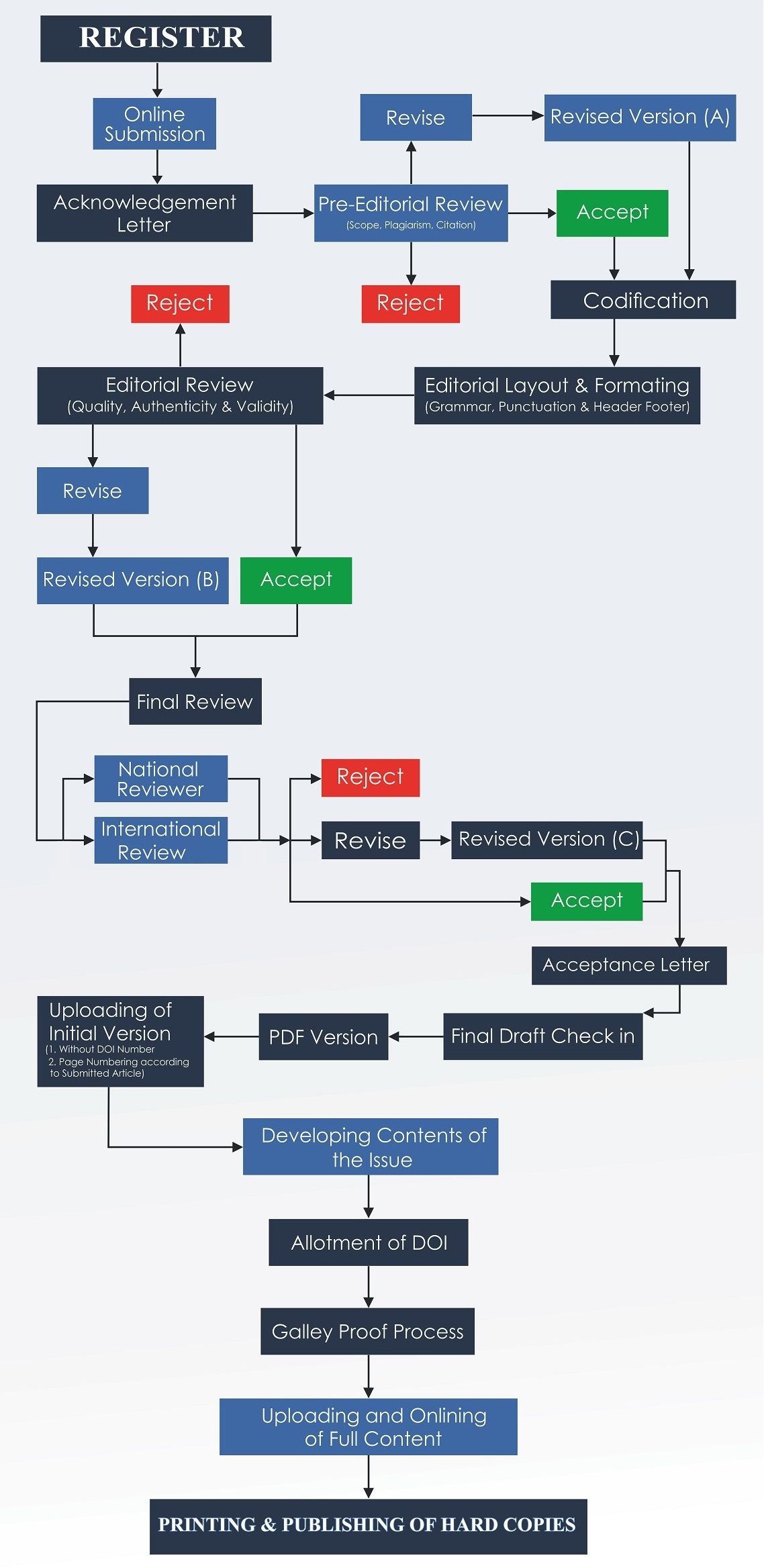
Review Process
The International Journal of Islamic Economics and Governance (IJIEG) follows a rigorous, transparent, and ethically grounded review procedure to ensure academic quality and integrity.
1. Initial Editorial Screening
All submitted manuscripts are first evaluated by the Editorial Office for:
-
Relevance to the journal’s scope
-
Originality and scholarly contribution
-
Significance and reader interest
-
Adequacy of documentation and referencing
-
Clarity of composition
Manuscripts not prepared in accordance with the journal’s submission and formatting requirements may be returned to the author for correction before formal review begins.
2. Similarity and Plagiarism Screening
All submissions are screened using Turnitin or an equivalent similarity-detection system. IJIEG follows the HEC Anti-Plagiarism Policy, under which the similarity index serves as an indicator requiring editorial interpretation rather than a standalone decision tool.
As a general benchmark under HEC guidance:
-
A similarity index above 19% may lead to rejection or conditional editorial handling.
-
The findings and conclusion sections are treated more strictly (normally not exceeding 9% similarity).
-
Significant similarity from a single source (e.g., 5% or more) is carefully examined.
Manuscripts with problematic overlap may be returned for clarification, revision, or rejected depending on the severity of the issue.
3. Double-Blind Peer Review
Manuscripts that successfully pass the initial editorial screening are forwarded to two external expert reviewers under a double-blind peer review system, in which the identities of both authors and reviewers remain anonymous. Reviewers evaluate submissions on the basis of academic merit, originality, theoretical contribution, methodological rigor, and alignment with the journal’s aims and scope. Where necessary, manuscripts are also assessed for statistical and methodological soundness, ethical compliance, technical accuracy, and language quality to ensure scholarly integrity and clarity prior to publication.
4. Revision and Re-Assessment
Authors receiving revision requests must submit:
-
A revised manuscript
-
A detailed point-by-point response to reviewer comments
Revised manuscripts are evaluated to ensure that reviewer and editorial concerns have been adequately addressed before a final decision is made.
5. Editorial Decision
All accepted manuscripts undergo language and copyediting for scientific clarity, accuracy, and consistency. The Editorial Board reserves the right to make the final decision regarding acceptance or rejection at any stage of the publication process.
6. Allegations of Misconduct
If the Editors become aware of allegations of research misconduct related to a submitted or published article, IJIEG follows the principles and procedures outlined by the Committee on Publication Ethics (COPE). Appropriate actions may include investigation, correction, retraction, or other remedial measures in accordance with established ethical standards.