Religion and Politics in Pakistan: The Weaponization of Faith
DOI:
https://doi.org/10.58932/MULG0063Keywords:
Islamization, Political manipulation, Sectarianism, Extremism, Pakistan, Religious politicsAbstract
There are many religions in the world and people in different regions practice different religions. Sometimes religious beliefs are exploited to achieve certain selfish interests. Muslim Majority of the subcontinent gained independence in the name of religion and as a result, Pakistan came into being on 14 August 1947. The analysis of religion and politics reveals that the interplay of external and internal forces has contributed to extremism and political sectarianism in Pakistan. From the beginning, the leadership in Pakistan struggled to sustain an ideological foundation based on religion, Islam. The research examines how different factions have deliberately exploited Islam to advance political agendas and vested interests. Moreover, the use of religion as a tool for personal interests has significantly influenced the development and peaceful co-existence of the country. This research not only highlights the role of religion in the politics of Pakistan during post-partition but also in the context of different governments of Pakistan such as the eras of Bhutto and General Zia. Furthermore, during the government of Zulfikar Ali Bhutto and General Zia-ul-Haq religion was part of politics to develop narratives in favor of their governments to consolidate power. Similarly, the policy of Islamization was used to manipulate people’s narratives by the use of religion. The post-9/11 era witnessed the repercussions on the political fabric of society due to the intensification of radical forces and the surge in regional and extra-regional actors. The recent incident in Parachinar also highlighted the challenges Pakistan is facing due to the complex interplay between religion and politics. Over the past 76 years of independence, the vision of a Democratic Islamic Republic remains vague. This research attempts to study the complex relationship between religion and politics and the ongoing challenges faced by Pakistan from multiple perspectives so that one can find ways forward.
References
Aguilar, M., I. (2024, June 11). Contextualising Zia-ul-Haq’s Islamisation of Pakistan (1977-88) and its impact on “non-Muslims” in the thought of Maududi and British colonialism. https://research-repository.st-andrews.ac.uk/handle/10023/29330
Asfaham, M. a. *. I. A. *. (2022, January 20). Domestic Policies of General Zia Ul Haq towards Islamization during 1979-88. https://www.harf-o-sukhan.com/index.php/Harf-o-sukhan/article/view/274
Esposjto, J. L. (1982). Islamization: religion and politics in Pakistan. The Muslim World, 72(3–4), 197–223. https://doi.org/10.1111/j.1478-1913.1982.tb03244.x
Tahir, S. (2015). Islamization process in Pakistan: Implementation of islamic laws against socialism scheme of Bhutto by Pakistan national alliance (PNA) and Zia. Pakistan Journal of Society, Education and Language (PJSEL), 1(2), 60-75.
Haque, Z., & Gardezi, H. N. (1991). Islamization of Economy in Pakistan (1977-88): An Essay on the Relationship between Religion and Economics [with Comments]. The Pakistan Development Review, 30(4), 1105–1118. https://www.jstor.org/stable/41259524
Hassan, R. (1985). Islamization: An analysis of religious, political and social change in Pakistan. Middle Eastern Studies, 21(3), 263–284. https://www.jstor.org/stable/4283071
Nasr, S. V. R. (1992). Students, Islam, and Politics: Islami Jami’at-I Tulaba in Pakistan. Middle East Journal, 46(1), 59–76. https://www.jstor.org/stable/4328393
Nasr, V. R. (2000). International politics, domestic imperatives, and identity mobilization: sectarianism in Pakistan, 1979-1998. Comparative Politics, 32(2), 171. https://doi.org/10.2307/422396
Nation. (2022, November 18). Politicisation of religion and its implication in Pakistan. The Nation. https://www.nation.com.pk/19-Nov-2022/politicisation-of-religion-and-its-implication-in-pakistan
Nawaz, M. (2020). Islamization of the Constitution of 1956: The role of Religious, Political Parties - ProQuest. https://www.proquest.com/openview/58d1ddf9925462d1100c54f9093e8dd0/1?pq-origsite=gscholar&cbl=2040111
Research Guides: Organizing Academic Research Papers: Types of Research Designs. (n.d.). https://library.sacredheart.edu/c.php?g=29803&p=185902
Shafiq, K., Khan, A. B., Liaqat, B. B., & Shah, A. S. (2020). The problem of institutionalization of political power in pakistan: an appraisal of the Zia period (1977-1988). Review of Economics and Development Studies, 6(2), 539–545. https://doi.org/10.47067/reads.v6i2.221
Sharif, M. M., & Sadiq, M. (2024, June 30). Pakistan’s political use of Islam: A historical discourse. https://prjss.com/index.php/prjss/article/view/139
Shiism and Sectarian Conflict in Pakistan: Identity Politics, Iranian Influence, and Tit-for-Tat Violence. (2010). Project on Shi’ism and Global Affairs. https://shiism.hds.harvard.edu/publications/shiism-and-sectarian-conflict-pakistan-identity-politics-iranian
Sultana, M., & Falki, S. M. (2023). Interplay of Religion and Politics: A Historical Account of Islamization and State Discourses in Pakistan. ojs.pssr.org.pk. https://doi.org/10.35484/pssr.2023(7-III)86
Wachani & Saeed, (2021). Controversial status of objective resolution in the form of article 2a in the constitutional history of Pakistan. Pakistan Journal of International Affairs, 4(2). https://doi.org/10.52337/pjia.v4i2.186
Weiss, A. M. (1985). Women’s Position in Pakistan: Sociocultural effects of Islamization. Asian survey, 25(8), 863–880. https://doi.org/10.2307/2644115
Zaman, M. Q. A. (1998). Sectarianism in Pakistan: The Radicalization of Shi‘i and Sunni Identities. Modern Asian Studies, 32(3), 689–716. https://doi.org/10.1017/s0026749x98003217
Zubair, M., Raza, A., & Islam, S. (2022). The coexistence of religion and politics in Pakistan: an analysis of historical, social, and political factors. Journal of Humanities Social and Management Sciences (JHSMS), 3(1), 435–446. https://doi.org/10.47264/idea.jhsms/3.1.30
Downloads
Published
How to Cite
Issue
Section
License
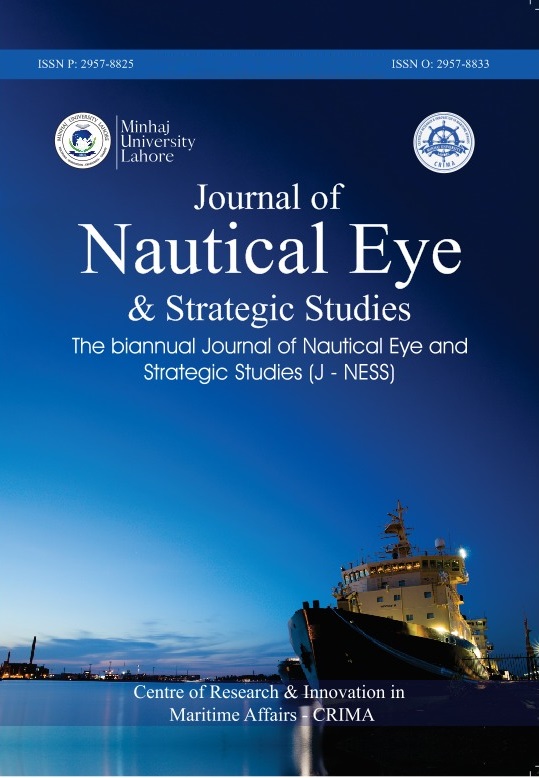
Copyright (c) 2025 Journal of Nautical Eye and Strategic Studies

This work is licensed under a Creative Commons Attribution-NonCommercial 4.0 International License.